Visiting Adalaj had just ignited the passion for visiting stepwells in me and one Saturday morning while I was out bicycling with my camera slung across my shoulder, a random bearded guy smiled and waved at me. I stopped, we chatted and that’s how I met my stepwell brother Amrit Sharma.
Meanwhile, I had read about a couple of stepwells in some place called Asarva (pronounced Asarwa) on a blog by Siddhartha Joshi. I told Amrit about my desire to visit these stepwells and the very next day (the temperature was exceptionally high for a February day) we boarded Raval Bhai’s auto rickshaw and went to Ahmedabad in a bid to hunt Asarva. Our first stop was, however, at a beautiful Jain temple called Hutheesingh Temple, of which I will speak later. By the time we came out of the temple, the sun was kind of sending down heat-shafts from the zenith. We refilled our water bottles at the temple tap and climbed into the auto rickshaw again with an ambition to find Asarva and its stepwells.
Google map didn’t help much, and we navigated with help from people on the street. My eyes were untrained then, and the entrance to our first targeted stepwell – Dada Harir ni Vav was not very prominent. It took us some time going up and down the same street till someone showed us the exact location.
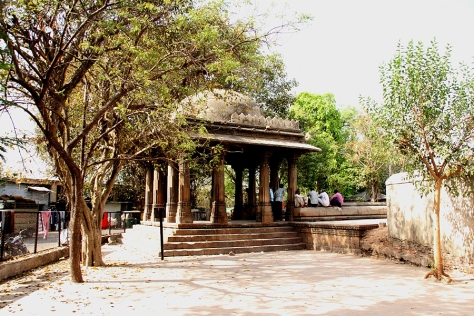
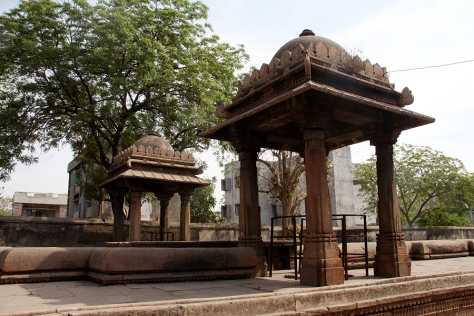
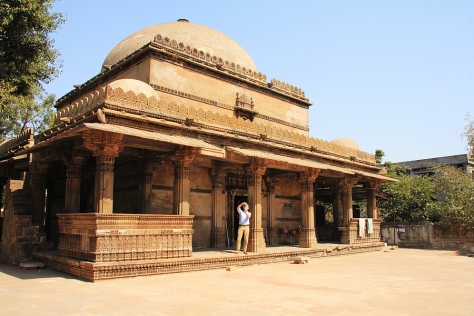
Within a fenced off area stood a domed canopy that looked like a tomb. A group of boys were playing there, their bicycles leaning against an old wall nearby. This place was so devoid of tourists, unlike Adalaj, that these boys seemed very privileged to have us and all of them followed us around as we explored the stepwell.
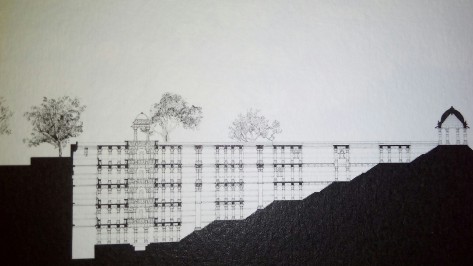
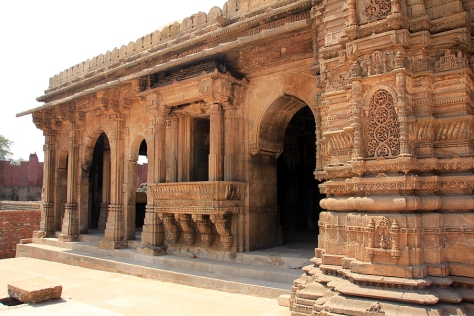
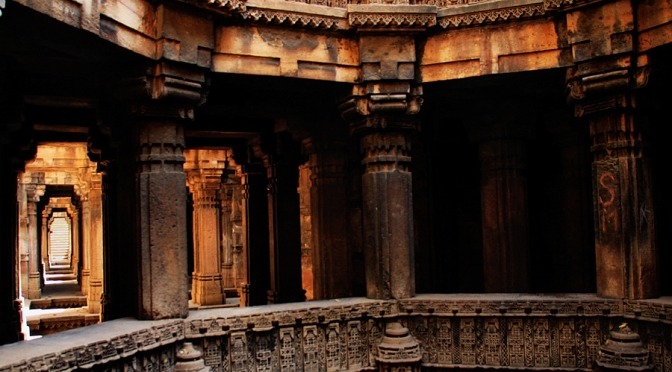
The dome was actually the umbrella to the pillared entrance pavilion from where the stairs lead you into the dark sombre depths of the five-storied well.
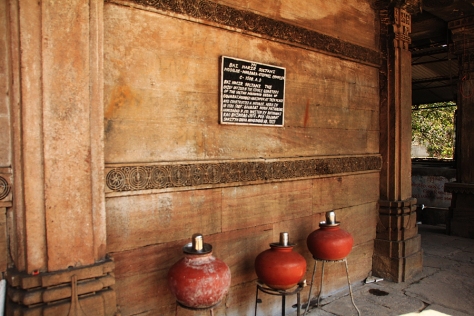
There were two inscriptions, enclosed in shallow niches of shrines with minarets, one on each side-wall, the left in Sanskrit (but in an informal handwriting type script) and the right in Arabic or Persian.
According to Wikipedia:
The Arabic writing reads:[1]This holy and wholesome water; the splendid travellers’ rest-house enclosed on four sides by carved and painted walls, and a grove of fruit trees with their fruit, a well, and a pool of water for the use of man and heist, were built in the reign of the Sultan of the Sultans of the age, established by the grace of God and of the faith, Abul Fath Mahmud Shah, son of Muhammad Shah, son of Ahmed Shah, son of Muhammad Shah, son of Muzaffar Shah the Sultan, may God keep his kingdom. Dated the metropolis of the kingdom the 2nd of Jamadi-ul-awwal in the 26th year of the reign.
A Sanskrit inscription says that the step-well was built in 1500 AD. It was during the reign of Mahmud Shah that Bai Harir Sultani, locally known as Dhai Harir, built the step-well. The name later corrupted into Dada Hari. It costed 3,29,000 Mahmudis (₹ 3 lakh) at that time. The ornate step-well has spiral staircases pieced into the sidewall of the well shaft and descending to the different platform levels.[1][2]
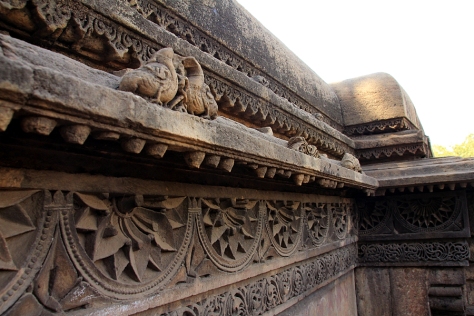
The walls themselves were dark pink with darker markings on them, in a way much darker and serious looking than the orange-yellow-pink walls at Adalaj. The overall look was also much less ornate and definitely sober. However, there were carvings of both Hindu Gods and Islamic motifs, of peafowls kissing/beak fighting, elephants in cavalry and the customary Pot of Ambrosia (Amritkalash) and the Tree of Life (Kalp-vriksha).
Amrit Kalash
Kalp-vriksha
Like the inscriptions, these low relief sculptures were also niched within high relief minarets with geometrical carvings. The prominent sculpture that ran along the walls were of a line of large lotuses (Hindu), accentuated with a narrower line of floral vines (Islamic) below.
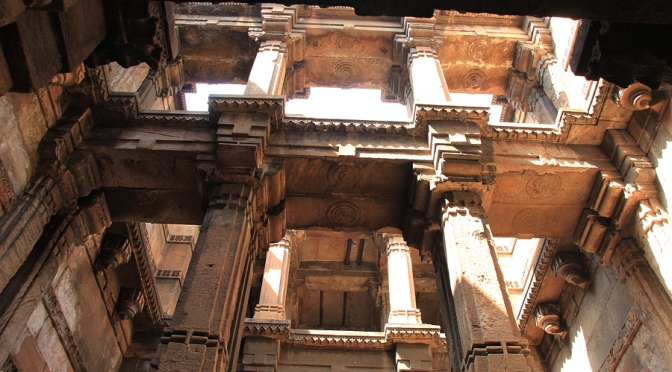
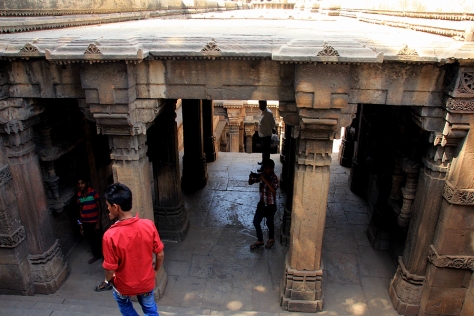
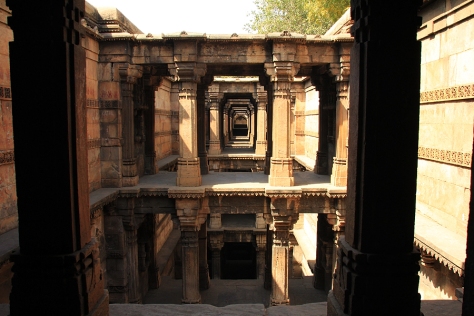
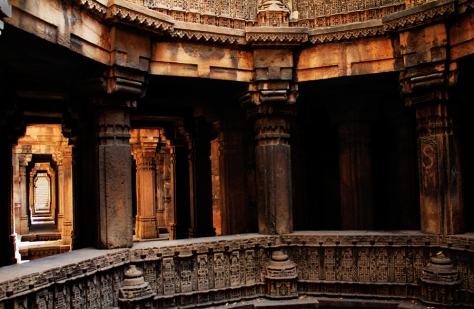
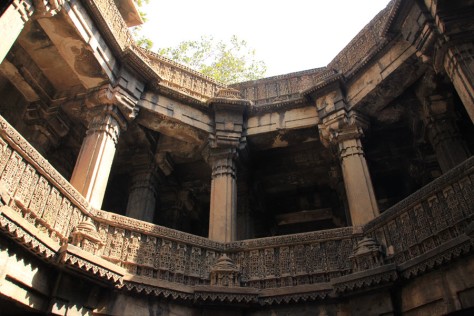
From the second level (the ground level being the first), the stairs led to the third and so on until the fifth. Seen from the landing, the pillars and beams above looked impressive, though devoid of the heavy ornateness as compared to Adalaj.
But before we continued our descent, it was fascinating to see how at each landing, the floor of one level (ceiling of the one below) has been cut away leaving only a ledge along the walls, to allow light to the next level.
If you had a brave heart you could walk along these ledges to reach the platform on the other side. We did that, and from here we could see the well shaft, at a distance, with the customary seat that had the backrest towards the shaft.
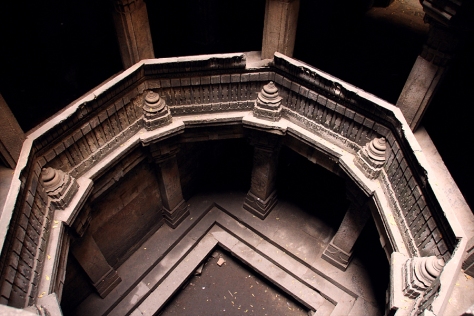
And then across one more ledge and one more platform and we were on the balcony that surrounded the octagonal Kund well pavilion. The well (Kund) below was, however, a square one. Filled up with silt till the brim, it looked like a courtyard instead.
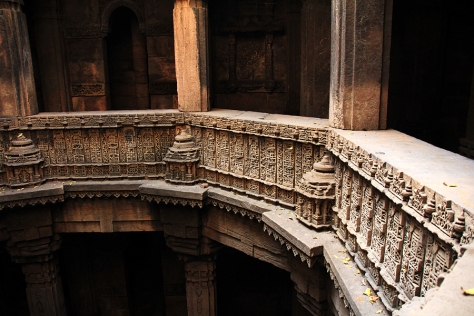
These octagonal balconies (galleries) were at each level, both above and below us. From above, we heard people’s voices and saw a group of foreign tourists with probably a local guide. The boys who were constantly on our heels immediately left us to join them; thank God!
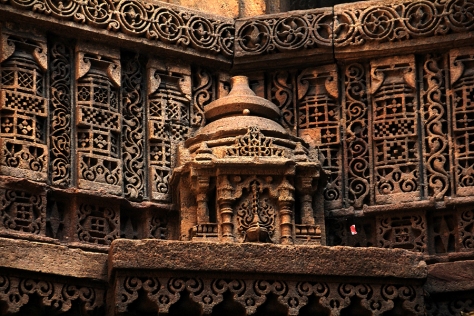
The sculpture on the outer walls of the parapets (low walls railing the galleries) were mind blowing. Repeated rectangular patterns with elaborate geometric cut-ins and cut-outs, punctuated at eight places (corresponding to the eight pillars) by little domed shrines.
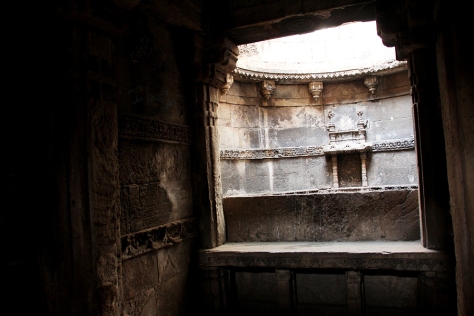
Between the two pillars opposite to us, we could see a window cut in the wall that revealed the well shaft. The wall of the shaft directly opposite to the window held yet another Kalp-vriksha enclosed in a shallow-cut shrine. A line of rock-cut birds emerged from each side of the shrine and probably continued along the circular wall.
We went ahead for a look into the well shaft.
Looking behind, the stairs through which we have descended looked surreal in a strange orange midday light, contrasting starkly against the dark recesses.
Gallery around the central kund of the stepwell, Asarva
From the gallery, a pair of narrow spiral staircases went up to the ground level and down to the lowest level.
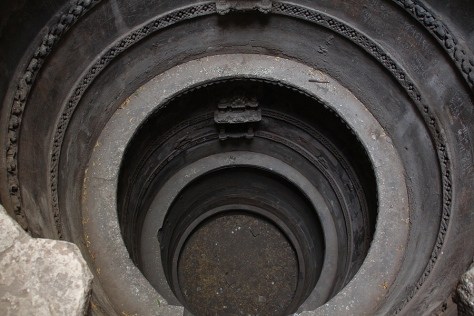
I entered into one of the spiral stairwells and was greeted by a flock of disturbed bats flying out through the opening I got in. A few bats still hung on (literally) but I could not get proper photographs due to poor light. I went down the entire flight till the lowest level. Looking up from the Octagonal Kund was a delightful experience. I always find myself enjoying looking up well shafts and deep recesses of Kunds, looking at the world I reside in with a different view. Deep within the ground the spaces are so fantastically semi-dark, cool and silent, and from the world above sounds of traffic, of humans shouting and pigeons cooing all appear to be mixed up in a faint din that seems almost unreal. Inside the earth, it smells differently too, of age old baths, fragrances of queens and kings, incenses, faint aroma of lichens growing on the stone walls, overpowered sometimes with the strong stench of bat guano.
I heard Amrit calling me and climbed back the spiral stairs, promising myself to bring a torch next time to see and photograph the bats. I stopped at each level, trying to photograph the various evolving forms of the Kalp-vriksha motifs and then appeared on the ground level to be greeted by two small domes or cupolas.
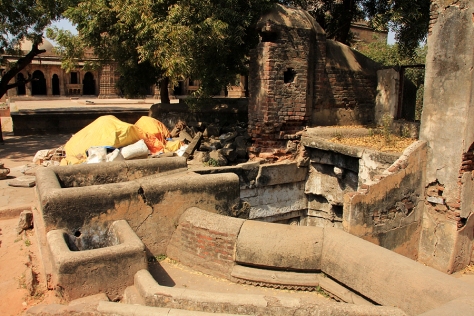
The structure that drew water from the well shaft (probably) a housing for the pulley systems was broken and big chunks of sculpted stone lay here and there. The channel to carry water for cattle was also half broken.
Broken and uncared for, the remains of the water drawing system and the cattle waterer. The background shows a mosque.
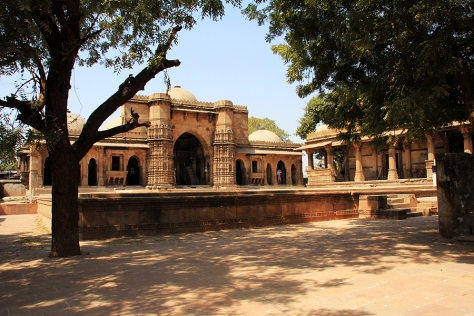
We left the well and went ahead towards what seemed a beautiful mosque located within the same compound.
The mosque had beautifully carved pillars and walls, a large dome flanked by two smaller ones at a lower level and inside there were vaulted ceiling corresponding to the domes. The striking feature, however, was the presence of the two Solanki style balconies.
The caretaker of the mosque, Mr. Mahmud, a white-bearded old man, showed us around enthusiastically.
There was a narrow turret that led to the mosque’s roof and Mahmud gestured us to venture up. Climbing up these age old stairs, I felt how before the loudspeakers came into use, the Muazzin would climb these flights five times a day and cry out the prayer call. On the roof, I could touch the domes and it was the first time I was on the roof of a mosque, so it felt really wonderful.
After visiting the mosque we went into another similarly fashioned building, but less sculpted.
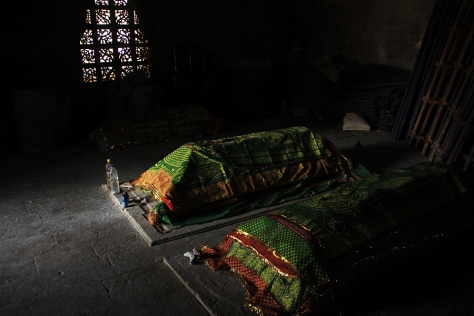
This was the maqbara or the tomb of the queens and also housed the grave of Bai Harir, the lady who was the guard of the royal harem.
It was Bai Harir who built the entire complex of mosque, maqbara and stepwell. Some texts refer to her as Dhai Harir (Dhai = Midwife). And the original name of the stepwell was Bai Harir ni Vav (Bai Harir’s stepwell) which later got distorted into Dada Harir ni Vav (Dada = Male deity). But it was not a Dada, but a lady who thought to provide water to the thirsty humans, animals and spirits in the drought stricken region.
P.S: As my interest in stepwells surged, I ordered the book “Steps to Water: The Ancient Stepwells of India by Morna Livingston. On page 31 of her book Morna writes, An inscription in the early sixteenth-century Dada Harir Stepwell praises the Mother Goddess Devi, who exists “in the form of wells”36 and as pure water, is “every drop a Goddess.”37 (36 – Inscription on Dada Harir, Jain Neubauer, Stepwells of Gujarat, appendix 2. 37 – Eck, Banaras, 61)
And now I have one more reason to revisit, other than the bats.
This year’s monsoon was a bit too much for Gujarat, and parts of the Acacia dotted sandy landscape of Banni in Kutch, now resemble lakes with vegetation jutting out like little green islands. As our truck moves along the Bhirandiara-Dhordho route, the familiar sandy expanse is back, and so are the grazing cattle – the bighorn Kankrej cows and the Banni buffalos with their donut horns.
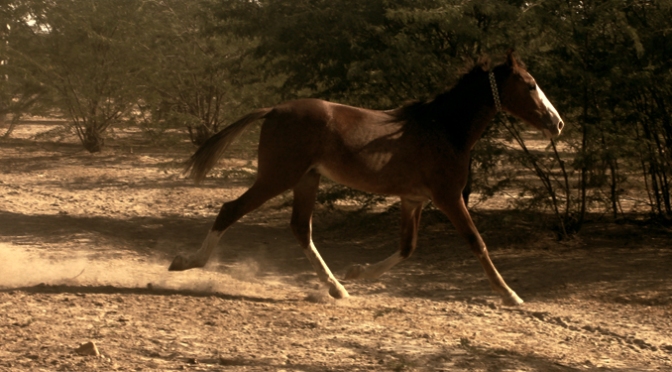
Suddenly, across the irregular rows of Mesquite scrubs, my eyes catch a glimpse of a few animals – not buffalos or cows, not even the run of the mill sheep herds, but a pack of horses. Half a dozen of them, including small foals, they browse on the thorny scrubs. I ask Rasool, the owner and driver of the pickup truck we are in, to stop, as we jump down, cross the road and stealthily approach the pack. The horses prick their ears sensing our approach, allow us till a certain distance and then take off like wild winds. Their backs glistening in the desert sun, untrimmed manes waving like the sedgebrush in the meadows, they run away from us, their hooves beating like drums on the dirt tracks from where tiny whirlwinds rise towards the sky.
Mustangs of Banni – Sindhi horses. Pic: Sudip Adhikary
This is the Wild West of India, and these Mustang-like beasts are the Sindhi horses. “This is gonna be exciting!” I tell myself. I am on my second visit to Banni grasslands, this time to know more about the Sindhi horses. And watching them run wild across the desert definitely signifies a great beginning.
My friend Ovee Thorat is a scientist working at the RAMBLE field station in Hodka, a small village in Banni area of the Rann of Kutch and it was on her invite I visited this region last winter. Back then, she had taken me to meet Haji Jafar, a well-known horse enthusiast and breeder of this region. That was my first tryst with the Sindhi horses, igniting a quest to learn more about these desert steeds.
It was in Jafar’s backyard, I first got to know about the distinctiveness of the breed and the constant but uncharted effort that Jafar and his likes were investing in to keep the breed alive. Under the shades of the Babool trees in the yard, we had found seven horses – grownups and yearlings among them. A few others roamed about at a distance, grazing on the desert scrubs. Jafar talked about each horse as he showed them – pointing out the differences between the Kathiawaris and the Sindhis, about their physical traits and about their spirits and characters.
Haji Jafar at his house in Dumado village of Kutch with one of his stallions. Pic: Sudip Adhikary
Western India has produced three important breeds of horses – the Marwari of Marwar region of Rajasthan, the Kathiawari from Kathiawar area of Gujarat and the Sindhi that probably originated in the hills and deserts of Sindh (now in Pakistan).
Ear shapes and face profiles of the three Western Indian breeds. L to R: Sindhi, Kathiawari and Marwari. Illustration: Sudip Adhikary
Of all these breeds, the Sindhi is the least described, in spite of carrying a rich history behind it and a huge significance in shaping the socio-cultural characteristics of Sindh and Kutch, not much is known about this breed.
A three month long hunt and then connecting the dots gives me a sketchy idea of what might have happened through the ages. Dr. Parkash Singh Jammu, ex-professor – Sociology and Social Anthropology, Punjabi University, Patiala, talks about the Kamboja tribe, who were pushed from Tajikistan area by the Mongols around 4000 B.C. These people, settled in the regions of present day Afghanistan, were expert horse riders and breeders, who continued their trade of horses with Europe through the Silk Route. Another researcher, Deepak Kamboj, writes “Throughout the Indian literature, the Kambojas are honoured for their horses. All major Indian religions have a lot to say about them. Jain Canon Uttaradhyana-Sutra informs us that a trained Kamboja horse exceeded all other horses in speed and no noise could ever frighten it. The epics, Puranas and numerous other ancient Sanskrit texts all agree that the horses of the Kamboja, Bahlika and Sindhu regions were the finest breed.”
What I gather from Dr. Jammu’s and Deepak Kamboj’s documents (www.kambojsociety.com) and from the writings of noted Sindhi historian Muhammad Hussain Panhwar, can be summarized as:
The Sanskrit description for Kamboj people is Ashvaka, meaning horse people or riders. Many historians like Christian Lassen, Saan Martin, L. Bishop, Dr. J. C. Vidyalnar, Dr M. R. Singh, William Smith, N. L. Dey, William Crooke and Kirpal Singh are of the opinion that the word Afghan has been derived from Ashvakan. J. W. McCrindle in ‘Megasthenes and Arrian’and ‘Alexander’s Invasion of India’, observes, “The name Afghan has evidently been derived from Asvakan, the Assakenoi of Arrian.”
Kamboja warriors played an important part of the cavalry during the Mahabharata war, both on the Kaurava’s and the Pandava’s sides. At the end of the war, the Kamboja warriors of the Kaurava side were taken as slaves by Krishna to Gujarat. These people were freed after thirty six years and settled in the kingdom. The Kambojas from the Pandava’s side however went ahead to settle in present day Sindh and Punjab.
Kamboja people have been mentioned time and again in literatures like Periplus of the Erythrean Sea, Patanjali’s treatise, Kalika Purana, Buddhist Jataka text, Arthashashtra of Chanakya, and Abu L Fazal’s Aina-i-Akbari.
Kamboja cavalry fought in various battles; as supporters of Haihaya Yadavas against Ikshaku ruler Bahu (Puranas), as allies of Magadha king Jarasandha against Krishna (Bhagwat Purana), as mercenaries for both sides in the Kurukshetra war (Mahabharata), as supporters of sage Vashishtha against king Vishwamitra (Ramayana), with the Persians against the Greeks (Herodotus, IV.65-66), in the army of Chandragupta Maurya (Mudra Rakshasa) and Brihadratha Maurya (Kalika Purana), as a part of the Pala army of Bengal (Mungher Inscriptions B.8, V.13), and as cavalry for the Gurjara-Pratihara rulers (Dr H. C. Ray, Dr R. C. Majumdar). The Aina-i-Akbari by Abul Fazl Alami mentions the 9000 strong Kamboja cavalry of General Shahbaz Khan that Akbar used for various conquests.
Kamboja people and their horses can be traced to two regions; one of them the Kambu mountains in Sindh, facing Lakhi Hills across Baran valley, half way between Hyderabad and Karachi and the other being Kutch (Kamboja > Kavoch > Kaoch > Koch > Kutch).
An 11th century sculpture of Kalki on the walls of Rani Ki Vav (Queen’s Stepwell) in Patan, Gujarat. The horse looks Sindhi in appearance. Pic: AuthorThe members of the Garasia tribe offer figurines of horses (sometimes with a rider) to their guardian deity Bhavsingh, near Patan, Gujarat. Pic: AuthorIn their horsemanship and dress the people of Kutch bear similarities with the Ashvakas (Afghans). Pic: Sudip Adhikary
So, horse breeding and trading across the Middle East to India continued through the Mughal era. ‘Riding Through Change – History, Horses, and the Restructuring of Tradition in Rajasthan’, Elizabeth Thelen’s thesis for University of Washinton, Seattle, mentions “Perhaps through its connections with (Mughal) court nobles, the horse became a symbol of nobility and fine manners. An encyclopedia of the horse, the Farasnama, was developed that drew from both the Indian tradition of Shalihotra, illustrated manuscripts detailing the care of the horse, as well as Persian Furusiyya literature, which is a collection of horse lore.”
A page from Sanskrit illustrated text Shalihotra. Source: Wikimedia Commons
However, the British stressed upon imported breeds for both their civilian and cavalry requirements and the Indian breeds were deliberately pushed towards extinction. Jos J. L. Gommans, in ‘The Rise of the Indo-Afghan Empire c. 1710-1780’, points out “Toward the end of the eighteenth century the horse trade began to decline in India because of pressures from the British East India Company (EIC), which settled in Bengal in 1757. Trade became more difficult in EIC controlled areas as the EIC attempted to control the movements of the horse traders and the EIC settlements blocked some routes.”
Nidhi Sharma, in ‘Transition from Feudalism to Democracy: A Study of the Integration of Princely States of Rajasthan (1947-50 AD)’, writes “Under the British paramountcy, local breeding of horses and the horse trade continued to decline. The imperial service troops were equipped in the British style so local breeds became less viable in cavalry units. The agreements often stipulated the type of horses. For instance, the Jodhpur Lancers were to be mounted on Arab, Valer (Australian thoroughbred) or English thoroughbred horses.”
John Lockwood Kipling, in his book ‘Beast and Man in India: A Popular Sketch of Indian Animals in their Relations with the People’ (1904), shares his British scorn for the Indian breeds, “The animals most liked are the stallions of Marwar or Kathiawar. White horses with pink points, piebalds, and leopard spotted beasts are much admired, especially when they have pink Roman noses and lightly-coloured eyes with an uncanny expression. Their crippled, highly arched necks, curby hocks, rocking gait, and paralytic prancing often proclaim them as triumphs of training.”
His son, the famous author Rudyard Kipling, in his epic novel Kim portrays Mahbub Ali, a Pashtun (Afghan) horse trader as the main ally of the protagonist Kimbal O’Hara (Kim). Throughout the novel, Rudyard uses different proverbs and statements that have some horse connection. The novel also talks about the Kathiawar (Kathiawari), Kabuli, and Balkh horses other than the Arab and the Polo Pony. But the breed Sindhi is mentioned nowhere.
Perhaps their fervour to exterminate the prominent native breeds were focused on the elegant looking Marwari (of Rajput pride) and Kathiawari (of the Gujarat royals) that the plain and endurant Sindhi, the horse of the nomads, got little attention. It therefore remained, free-ranging in the deserts of Kutch and the hills of Sindh, helping the Maldhari cattle-grazers move camp from one pasture to the other.
Back in Ahmedabad, this July, I remember speaking to Anish Gajjar, equestrian Trainer, riding instructor, and founder member of Equestrian Club of Gujarat. As we sat across the table in a cafe on that rainy evening, the enthusiasm in his voice as he spoke about the Sindhis was not to be missed. “There is a lot of diversity in this breed, and I favour this breed. They are very good for long rides. A good quality Sindhi can go up to 40 kms per hour in Rewal (Amble). But the Fédération Equestre Internationale (FEI) and the Equestrian Federation of India (EFI) are yet to see this breed participate. I believe, properly trained Sindhis will do great in events like pole bending, obstacle racing, barrel racing, and endurance riding.”
Having trained over 160 horses and 450 riders in his work life of 20 years, Anish Gajjar nurtures hope and expectation from the Sindhi horses (not pictured here). Pic courtesy: HD Photography
“What about the breed standards?”, I ask. “There are no strict standards in place, or no list to conform to. A Sindhi you find in Kutch area will be different from one you find in Surat – these two being the main centres of breeding. In most places, the breed has got diluted in order to mate the stallion or mare with the nearest counterpart available. I have even found that an offspring from a Marwari stallion and a Marwari mare being labelled as Sindhi just because it had straight ears, instead of the curved ones. However, generally speaking, the domed forehead, straight ears with an inward curve at the tip (tulip ears), larger distance between the base of ears (compared to the other two breeds), an almost straight back, a sloping croupe (hips), and a low set tail are the characteristics of a Sindhi.”
Breed Characteristics of Sindhi Horses
The National Research Centre for Equines (NRCE), Hissar, Haryana, carried out a study on ten Sindhi horses of Banni region in Kutch, in 2013. According to the NRCE annual report the most distinguishing breed characteristics is the ‘typical shape of its nose- raised at its middle and dropping sharply at end of nostrils – parrot nose’. It also mentions that the distance between the ears (average 12.5 cm) is more than that of the Marwari or the Kathiawari breeds.
Biometric parameters
Centimetres
Range
Height at wither
149.25±1.44
139-156
Heart girth
167±2.23
157-176
Body length shoulder point to pin bone
88.8±1.28
82-96
Face length
52.1±.46
50-55
Ear to ear distance
12.5±.94
5.5-15.5
Chest
30.35±1.06
25-37
Neck length
51.9±1.25
46-58
Fore leg length
87.6±.94
83-92
Fore leg canon bone length
14.9±.38
12-17
Ear to mandible base distance
26.6±.58
24-30
Ear length outer side
19.7±.30
19-22
Ear length inner
15.8±.13
15-16
Biometric analysis of Sindhi horses of Kachh region
Source: RK Dedar, Nitin Virmani, RK Vaid and RA Legha, NRCE Annual Report 2012-13: P-47
However, Retd. Col. Sarpartap Singh, Vice President of the Indigenous Horse Society of India and President of the Lakhi Sindhi Horse Breeders Society, doesn’t agree to the breed characteristics specified by NRCE, mostly because the study was carried out on only 10 horses of one isolated region (Banni), where the gene pool is bound to be poor. According to him, the parrot nose is not a defining characteristic. Col. Singh mentions the general characteristics of the Sindhi horse as: a straight profile, domed forehead, larger distance between the bases of ears (than Marwari or Kathiawari), a longer barrel and a sloping croup.
This time, I head to Dumado, Haji Jafar’s village, a little more informed than last time. Knowledge that would help me look at these horses with a different eye. As we enter Jafar’s yard, he welcomes us with a smile of recognition. Jafar now has ten horses – mostly Sindhi. We talk about training –people familiar with the British style of horse training will certainly find a difference here. The training for horses here starts at the age of 24 months. The horse is first bridled (the reins put in) and taught to endure the bit in its mouth for a few days, a few hours each day. Once it is accustomed to the bridle, the Pachri (horse cloth) is put on its back and kept on for 2 to 3 hours for a few days. Then comes the time for putting up the saddle and the girth. After this, a young boy mounts the horse while an experienced rider uses a neck rope to lunge the horse in large circles. The bridle is kept on, and tugs on the rein coupled with the pull of the rope are used to associate the horse with the desired movements. About 8 to 10 days later the control is transferred to the bridle. After a month of riding, the horse is taught the famous Rewal Chaal or lateral ambling gait. Sindhis, like Kathiawaris and Marwaris are said to have a genetic trait for Rewal and a horse usually learns this in a month. Once the horse picks up this favoured gait, which allows it to run long distances without tiring itself or the rider, it is trained for the Rewal races. Each year, from October till February, about 15 to 20 races are held in the neighboring areas with the winning prizes ranging from Rs. 25000 to 50000.
Our conversation is interrupted as another horse owner brings in a mare for mating with one of Jafar’s stallions. Jafar instructs his brother to bring out the stud and both the horses are led towards the faraway scrubs, a young foal trotting behind the mare. Meanwhile, another family member brings out a young stallion for training, one of last year’s yearlings I recognize.
A mare from a neighbouring village is brought in for mating. Pic: Sudip Adhikary
From Dumado we now travel 12 kilometres ahead to Dhordho, famous for its white Rann. Here, Ovee has setup an appointment with Abdul Kalam Morana, another prominent horse breeder of the area. Morana’s house is within a high-walled compound, much in contrast with Jafar’s open yarded pastoral house, though both of them belong to the Maldhari community of cattle-grazing nomads. We meet Abdul Kalam Morana and his nephew Abdul Jalil, the horse trainer, in the sitting room that has its walls daintily decorated with traditional Kutchy mudwork. After the introductions I ask Morana about his horses. “I have four horses – a stallion of three years, an eight year old mare and her two fillies; one of 16 months and one of 3 months,” he proudly declares.
I want to know about the training. The sixty year old speaks, “Formal training starts at 24 months, but actual training starts from the time a foal is born. The handler touches the foal and caresses it so that it starts becoming familiar. It doesn’t object to the person’s presence near it or hides behind its mother anymore. At four months, we put the foal on halter and teach it to follow the handler. During this time it is also taught to rear up or to lift its legs on cue. At 18 to 20 months we put the horsecloth, saddle and girth and also the bridle. It is then led for walks up to half kilometre.”
“And do you put some weight on the horse after this?” I enquire. He says, “No, we don’t put dead weight like sacks of rice on the horse. A horse should be trained to carry a rider, a living being who can shift and adjust, not a dead weight that sags. It’s not a donkey!”
“At 24 months, the horse is bridle trained to move forward and backward. After this, the rider mounts the horse.” Morana continues. “After it gets used to the rider and doesn’t try to dislodge him anymore, it is taught the movements – Choubaz (trot), Mandri (canter) and Velar (gallop). The Varra or Rewal is not a movement, it’s a gait and the rider has to get this out of the horse. It takes about two months for the horse to learn and get the Rewal ingrained in it.”
Rewal
Rewal (Also known as Reval/Rehwal/Indian Shuffle/Lateral Amble) is a four beat gait where each leg of the horse touches the ground separately. It is a walk that can be carried out very fast, even up to 45 km/hour.
In the Rewal gait, the movements are left hind leg followed by left foreleg, and then right hind leg followed by right foreleg or the other way round.
In this gait, the backbone of the horse remains still even when it is running very fast. Because of this ‘almost no vertical movement’, a rider and horse can comfortably cover long distances like 60-75 kms at one go.
Horses born with the natural ability to perform Rewal are called Ambling Horses or Amblers and all the three Western Indian breeds are Ambling Horses.
After this brief chat, we are invited to take a look at the horses, and while we walk towards the stable, Morana talks about the Sindhi breed and its significance to his tribe. “We are Maldhari people, cattle-grazers. From time immemorial we have been roaming about in search of new pastures for our cows and buffalos. The Sindhi horse is indispensible for us. Even in these days, when you see us settled in houses and owning pickup trucks, we depend on the Sindhi when we have to go searching for a lost herd in the grasslands. A Sindhi can tolerate high and low temperature extremes of Kutch and can survive without special fodders. It grazes on the grasses and sedges on its own. It can cover a distance of 65 kilometres, with a rider, alternating between slow and fast paces, in three to four hours.”
Abdul Kalam Morana with Harini and Gudala. Pic: Sudip Adhikary
Abdul Jalil opens the stable door. It’s more like a corral with a covered shed at one end. A huge mare is seen munching on its fodder while the two fillies Harini (16 months) and Gudala (3 months) prance around. Gudala is curious; she rushes to check us out. Harini earns a stroke from Jalil. Later both of them go and snuggle around Morana. He carries on talking about his passion, “I have been riding since I was a six year old and training horses since I was around 11. These days, my nephew Jalil trains them. I only do test rides to check if the training is perfect and pass my feedback to him if any corrections are needed.”
Abdul Jalil with Harini. Pic: Sudip Adhikary
Though Morana talks about Sindhi horses being left open to the elements and surviving on desert vegetation, his horses are well-fed and sheltered unlike Jafar’s free spirits. Morana is serious; the stud he uses for breeding comes from a person in Navsari, a town 800 kilometers away.
We take leave from Morana and head towards a Maldhari settlement – a place where Rasool and his clan have put up a temporary camp after their village was washed away in this year’s heavy downpour. Rasool laments about the cattle and horses that were killed by the calamity as he drives us towards Hodka. Once again I ask him to stop the truck as I discover another pack of Sindhis cantering through the landscape, snorting and shaking their heads now and then sending faint clouds of dust flying out from their manes. The desert sun keeps glistening on the backs of the Sindhi horses. Mustangs of Kutch!
Sindhi horses in Banni Grasslands. Pic: Author
Acknowledgements: Ovee Thorat (PhD researcher, ATREE, stationed at RAMBLE, Hodka), Anish Gajjar (Equestrian trainer and founder member, Equestrian Club of Gujarat), Haji Jafar and Abdul Kalam Morana (Horse breeders at Kutch), Col. Sarpartap Singh (President, Lakhi Sindhi Horse Breeders Society) Rasool Jat (Maldhari herdsman and mini-truck owner), Dr. Masood Lohar (National Program Manager, UNDP-GEF Small Grants Programme, Pakistan) and Sudip Adhikary (Photography and Illustration).
Frankly speaking, I had not even the faintest idea about step wells. A few days after I arrived in Gandhinagar, my friend Kaushik suggested, “Go, check this Vav (step well) at Adalaj; it’s beautiful!” I didn’t pay much thought to it; I thought it to be something like the huge wells (10-15 meter diameter) I saw in Deoghar district in Bihar (I guess it is Jharkhand now) which had a single door halfway down on their walls that connected to the ground level above with a straight flight of stairs – a clever way to save your rope length when the water went really low in summer.
My initial idea of step wells!
BTW, I haven’t watched the Bollywood movie ‘Paheli’, neither the Hollywood flick ‘The Dark Knight Rises’ both of which feature the famous Chand Baori (step well) of Abhaneri, Rajasthan. It’s a different matter though that most of these Baoris of Rajasthan are more of stepped ponds than step wells or a hybrid of both as I later learnt from Morna Livinston’s book (More about the book later). The Baolis of Delhi (to learn about these visit my friend Somdeb Basu’s blog here) however are somewhat similar to the Vavs (pronounced between Vow and Wow) of Gujarat.
Quick facts!
Ok, getting back to Adalaj Step Well, I went there on a late December evening, when my friends Dr. Tanmay and Dr. Sanchita Mahapatra arrived from Kolkata (for an upcoming Kutch trip) and I wanted to take them somewhere on the first free day they had. I kind of went across the temple compound, walked up the stairs and ‘Whoa! What have I been missing all this time!” I thought aloud.
Well, well, well, from then on I started delving into the wells, literally and figuratively. I have been to Adalaj half a dozen times more after that; with my wife, with friends on visit, and even with the trainees of the ILP (Initial Learning Program) batches of my office.
A bunch of school kids on a visit to Adalaj step well
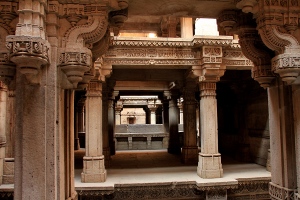
Other than the breathtaking sculptures at the first level, what greets you here is also the coolness of its recesses. This step well has five floors going down till the water level of the well shaft during the driest times. Oriented North-South, the entrance is at the South through three staircases from the East, South, and West. The southern stairs have been locked up and the western one leads to a manicured garden, so you will be entering through the eastern steps. At the first floor (of descent) you will be fascinated by the beautiful polygonal landing hall with intricately carved pillars.
A movie shoot in progress at the polygonal first floor landing hall
Don’t miss the walls though, for the relief work of elephants, women at work and daily life, and lion hunts could give you an impression of the age when this well was built.
Scenes from the past
On the four corners are little rooms with big windows opening towards the hall.
Little room, large window!
Look at the beams that run between these rooms and the pillars – the carvings will make you dizzy, “Hindu? Islamic? Persian? Jain? – what style is this?”
Now, if you want to untangle the puzzle, try to find the Sanskrit inscription nearby (I couldn’t). There is an English notice outside the well that talks about this inscription.
The notice that talks about the inscription
The history (with a pinch of legend added) says that the construction of this structure was started by a Vaghela Rajput ruler, Rana Veer Singh, who died during a battle with the Muslim (Persian) ruler Mahmud Begada. Begada, however, didn’t stop or hinder the construction but rather hastened it by bringing in more workers. This might have two reasons – 1. Throughout the history we find many Hindu structures being destroyed by Muslim rulers/invaders and many Jain/Buddhist structures being destroyed by Hindu rulers too, but none of them ever tampered with any step wells. Since these were rainwater harvesting structures built mainly for the subjects, no one dared to be the reason of their dissatisfaction. 2. It is said that Begada was attracted towards Rana Veer Singh’s widow, Queen Rudabai and wanted to marry her. Rudabai, agreed to marry Begada on a condition that he had to complete the construction of the step well first. But on completion of the structure in 1498, clever Rudabai called the priests to invoke the Goddess in the step well and make the water pious. Once this was done, she jumped into it and committed suicide. That kind of sums the presence of various architectural styles, sculptural styles and their mishmash in this well.
A mishmash of architectural styles
Coming back to the scene of action, from the hall you must turn right and get down the flight of stairs to arrive at the second floor and so on till the fifth. All along, the pillars and beams will fascinate you with their carvings.
On the walls on the east and west that lead till the well shaft, you will find large niches cut to form shrines – some of them bearing the carving of the Kalp-vriksha (Tree of Life) or the Amrit Kalash (Pot of Ambrosia).
The pillars and beams are joined by ornate structures carved of stone, ones that look like the tied up curtains or that look like the body of a scaled dragon or serpent.
At the fifth level, you will come near a squarish water body, now covered with a wire mesh to prevent people from jumping in. Below the translucent green waters, you can see coins shining – offerings from the devotees. On my first visit, I guessed this water body to be the well shaft, but later discovered it was the holy pond or Kund.
The KundThe Kund, post monsoon. Note the wire mesh is now invisible (submerged)
The well shaft lies behind it, cordoned off from public view. Once I visited Adalaj in the early morning, when the gates were not opened (they open the gates at 8 am). When we expressed our desire to visit, the priest in the adjacent temple suggested us to jump the gates. We did so, and discovered the step well once again. There were no visitors other than us, no guards too. So, we walked along the narrow ledges of the first floor pavilion, jumping over the bed of spikes put up on them to check people from this daredevil act. And only then, we could go till the well shaft. Looking down from the balcony with a sitting ledge, the back rest of which formed a part of the wall of the shaft, we saw the waters below and the carving of the twin fishes on the well’s distant wall. These fish relief, later I found in a few other step wells too, symbolizes the fertility of the water in the well.
Fish motifs in well shaft
Once done with your walk till the kund, you can climb up the stairs and go back to the hall on the first floor. From here, turn right and take the stairs on the west (opposite to the one you have used while entering).
The landing hall’s western stairs lead towards the garden
While getting out, look at the floral reliefs on the beam below which you passed and once out in the garden, look closely at the big Kalp-vriksha motifs carved on the half pillars (gate post type) at the exit.
Half-pillar with Kalp-vriksha
Now take the short flight of stairs to the roof of the step well. While walking along the edge of the elongated keyhole shaped plan of the step well (the round part being the well and the rectangular elongated parts the pavilions) you will find two spiral stair cases, locked now with wire mesh lids, that people could use to reach the well without going through the pavilions. Also take a look at the mesh covered well shaft though you wouldn’t be able to make out much in the dark abyss (except if it’s midday).
The well shaft: I put my camera and hand inside through a gap in the mesh and shot this blindly
While coming back, stop at the mounds on the roof. There were seven of these once, now five remain. The guard told me, these were the graves of the seven engineers/architects who had built this well. Apparently after the completion of the well, Begada had asked them if they could build another structure like this, to which they had confidently answered yes. The king, however, wanted his work to remain unique and unreplicated and thus put these poor fellows to the swords.
The graves of the engineers, they say
Personally, I don’t think this story as true, because one of the step wells at Asarva (Dada Harir ni Vav), also built during Begada’s reign, has a lot of similarities with the one at Adalaj and seems to be created by same set of architects. About Dada Harir ni Vav, I’ll tell you in my next post on stepwells.
November 16: This was our second and last day of the trip and we woke up to a foggy morning. Sitting on the porch of Habhu bhai’s house we stretched our limbs towards the merciful sun for a warm up.
Yesterday, after our visit to Jafar bhai’s place we visited Kala Dungar or Karo Dungar, the Black Hill. At 462 m ASL, it is the highest point in the Rann. On this hill, there’s a temple of Lord Dattatreya – a divine form where the trinities of the Hindu mythology, Brahma, Vishnu and Shiva are unified in the same body. There are three distinct heads though. Legend says, here the Lord had stopped once on his walk of the world, and seeing the hungry jackals, offered his own body as food to them. The ritual, these days, continued since the last 400+ years, is that the priests of this temple offer food to the jackals after the evening worship. And this was the sight we wanted to watch.
The afternoon was fading but the sun was still strong when we drove towards Khavda, a very prominent village and probably the last one before Kala Dungar, after which the land gives way to Pakistan border. We stopped here for a while and then proceeded towards the Black Hill.
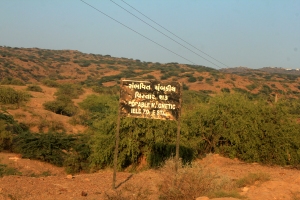
A notice declaring magnetic properties of the hill
On our way, we passed a magnetic hill, with a signage over it. I have seen a magnetic hill before in Ladakh and the fact is if you switch off your car engine and put the gear on neutral, the car will move upslope towards the hill. Some explanations refute the magnetic field claim and say that it’s a trick of nature where downslopes appear to look like upslopes. The apparent magnetic property of this hill near Kala Dungar was discovered recently (and proved wrong too).
Up towards Kala Dungar
The landscape has changed meantime; the long grassy flatlands lay far down below as our Bolero clambered up the winding Ghat roads. A bus load of tourists were heading towards the temple, but their bus could not cope up with the steepness of the slope. They parked the bus and started walking up. A little ahead, a camel, decked with a lot of hanging stuff walked down towards the village, with his master on his back. Ovee said, “Shahrukh Khan”! Well, that was the name of the poor camel that runs up and down the hill carrying tourists, of all sorts, on his back.
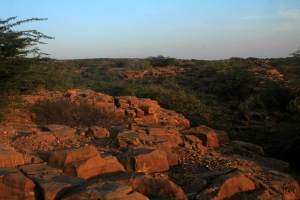
Kala Dungar landscape
A camel named Shahrukh Khan
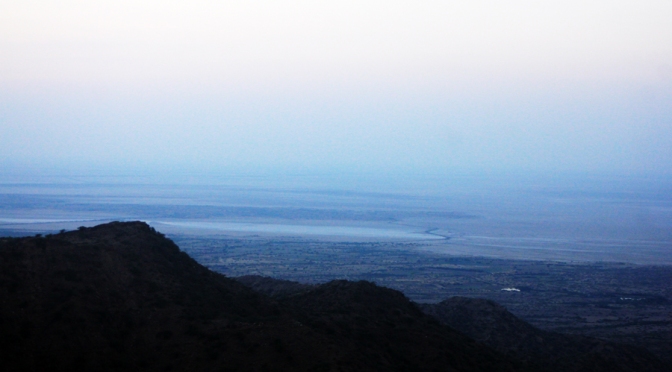
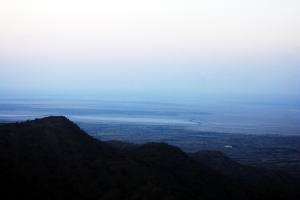
Up near the temple, when we parked our car, the sun was preparing to set. There was still some time for the evening worship and the jackals feeding, so we walked up towards the viewpoint. On the left (West), stretched the vast salt pans and the setting sun created it’s reflection on its surface. A few lights from the chemical factory in Khavda dotted the otherwise darkening scene. On our right (East) stretched a different vista – a slope running down to a rolling plain punctuated by little hillocks and finally hazing out into the sky.
The viewpoint atop Kala Dungar
The Western view
The Eastern view
Near the viewpoint, there was a BSF outpost and the captain invited us for tea. We said we would come back after trying our luck to watch the jackals. When we went near the temple, the prasad was already put out for the jackals on the designated podium. It was quite dark, and we could see the silhouettes of the wild canines gobbling up food. Soon though a pair of huge wild boars came in and the jackals were driven out from their century old rights.
Before walking back towards the BSF outpost, we looked around for hedgehogs but found none. After spending some time with the jawans at the tea table, we started on our way back. The weather was getting chilly.
After we came down to the plains, somewhere midway, we stopped in a village where Habhu bhai had his in-laws living. We were invited inside and had a chance to see some excellent samples of Kutchi handicrafts. There were patchwork items ranging from bedspreads to cushion covers, carved wood furniture and lot more. From here, I bought a pair of rag dolls and a nice embroidered bag. The inside walls of this house was adorned with mud and mirror work, typical of Kutch. Even the way they kept their utensils arranged in the kitchen was aesthetic.
Embroideries
Applique
Mud & mirror
Finally, we drove back to Bhirandiyara and lodged ourselves at Habhu bhai’s house. After meeting Habhu bhai’s mother, wife and three children, and then diving into a sumptuous home cooked dinner of roti, dahl and sabzi, we decided to call it a day. Charpais (rope beds) were laid out for us and our hosts provided each of us with three blankets to put on. We initially thought it as overkill but the midnight chill made us realize the significance of the third blanket and regret refusing the fourth.
Sourav on the charpai
We woke up at daybreak and were greeted by the warm kettle of tea on the hearth. And this is where we were now, warming up for the day ahead.
Morning!
Bidding goodbye to Habhu bhai’s household, we boarded Nekin’s Santro and reached the RAMBLE (Research and Monitoring in the Banni LandscapE) field station at Hodka. After the usual cleanup and brush up, we came out to meet Rasool bhai who had come with his Bolero. Our plan for today was to visit Chhari Dhandh, the largest wetland in the vicinity, before we leave for Ahmedabad.
Rasool bhai is a great driver and he knows this desert like the back of his hand. So, off we went through the sands and salts careful not to tread on the fallen branches of the thorny Prosopis juliflora. On those sandy stretches that seem to lead to nowhere, we saw a few motorcyclists now and then. Rasool bhai said they were going to some function (Majlis) in a village near Bhujardo.
Running through the Rann
A flock of common cranes were seen grazing in near the scrubs ahead of us. Rasool bhai stopped the jeep. But the birds were too wary and the moment we tried to walk towards them they all took flight. On our way to Chhari Dhandh we met more flocks of cranes but all of them behaved the same.
Common Cranes
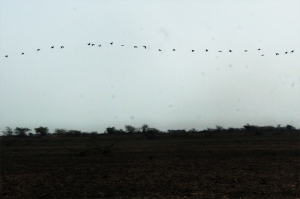
Common Cranes in flight
Now ahead of us stretched a vast mass of water, almost unreal that it seemed like a mirage in the salt desert that spread till the horizon. But this water body was real, because there were flamingos wading in it.
Flamingos!
Flamingos – yes, those majestic birds of dreams. We stopped the jeep about 300 meters away and started walking towards the shore. There were green bee eaters swinging on the tree branches, lapwings walking around in hurried footsteps and doves cooing about. In the mud I saw the tracks of jungle cats. About a 100 meters from the shore, it started getting muddy and too soft to walk ahead. So, I stopped and looked through my binoculars towards the water. Other than the flamingos there were a lot of ducks and waders.
Jungle Cat tracks
Meanwhile all my companions have started walking towards the watch tower. I decided to join them too. We climbed up the stairs and sat on the watchtower for some time – the desert wind blew into our faces. A harrier flew by, probably a Montague’s Harrier. Across the desert walked a Maldhari boy in his pink Afghani robe, may be towards his herd.
Through the desert
Kadambari and Megha bhai arrive
A dark blue Gypsy arrived and from it emerged Kadambari and her field assistant Megha Bhai. We greeted each other and spent some more time chitchatting. Then we parted. On our way back towards Hodka, we stopped to meet a group of camel herders, mostly because Rasool bhai wanted to fulfil Sourav’s wish to drink camel milk.
At the camel herders’ place (these nomadic people keep changing places, this was where Rasool bhai has seen them last) there were no camels. There was only an old man sitting in the sparse shade of the Prosopis trees, spinning wool ropes from camel hair. He said they have taken the camels to graze elsewhere.
Spinning Camelwool ropes
Grazing camels
We did see some camels later though, a herd tended by a few young kids. Rasool bhai drove us to a nice resort called Jheel (Lake). Ovee informed that this resort belonged to Megha bhai’s family. We explored around, looking at the Bhungas (the traditional, round, mud houses) and then the woman of the family showed us some splendid handicrafts.
Bhungas (traditional houses) at Jheel, a resort near Hodka
Ovee checking out some handicrafts
Near the dining hall there was a framed picture of Bollywood star Amitabh Bachchan sitting on a charpai near the Bhungas and interacting with this lady – a part of the Kutch Tourism Campaign tour. At the dining, Megha bhai’s brother served us a delicious lunch of rotis, several vegetable curries and dahls. It was time to bid goodbye. Habhu bhai, Rasool bhai and Ovee dropped us at the RAMBLE field station. We got back into the Santro and started our drive towards Ahmedabad. We would reach the city by evening today.
Breathtaking Banni: Part – 1 November 15: My friend Ovee Thorat is a scientist working with RAMBLE (Research and Monitoring in the Banni LandscapE) in the Banni grasslands of the fabled Rann of Kutch. And I had an open invite to visit their field station whenever I wanted. This weekend gave me the chance. My colleagues Nekin and Sourav agreed to join me and we decided to drive down the odd 400 kilometres on Nekin’s Santro. After office yesterday, Sourav and I had come over to Nekin’s house in Ahmedabad. The dinner, cooked by Nekin’s mom was fabulous and we had a good night’s sleep punctuated only by the rumble of trains running along the tracks close by. So, here we were, out on the road, Nekin at the wheel, me on the navigator’s seat and Sourav sitting pretty among our bags at the backseat, belting out selected tracks from his cell phone, which we have connected to the car’s audio. We’ve started at 5 am, and after two brief stopovers, we were nearing our destination – a village called Hodka.
This was our third stopover, at a chai shop near the Rudramata temple on the outskirts of Bhuj. We were not sure if we’ll be lucky enough to get lunch. It was 12-30 and we were snacking on Fafras and Jalebis, the only offerings this joint could serve.
Fafra (the long tube like things; salted) and jalebi (the spiral-rounded sweet stuff). Ignore the beauties in the background! 🙂
On our way, we have crossed the towns of Dhrangadhra – famous for the Wild Ass Sanctuary, Maliya – where the vast saltpans and the windmills mesmerized us, and Bhachau – one of the towns that suffered the worst during the infamous earthquake in 2001 along with Bhuj and Anjar. At Dhrangadhra, we saw a huge flock of Rosy Starlings. At Maliya I’ve seen my first Pacific Reef Egrets. And along the road noteworthy sightings included a flying flock of lesser flamingos, black shouldered kites sitting on the electric wires, and about half a dozen Montague’s Harriers in flight. About an hour more of drive now to reach Hodka via Bhirandiyara. Back to the car and DJ Sourav’s numbers! The road ahead was straight and narrow, but smooth. At Bhirandiyara we asked people and turned left for Hodka (locals often call it Hodko). For some reason, I haven’t been able to catch Ovee on the phone since this morning. I hoped my text messages reached her, and she would be at the field station when we got there.
The RAMBLE field station at Hodka, Banni.
The final 100 meters to the field station was along the dirt track that emerged from the road and ended near the famed Sham-e-Sarhad resort. We could see a few jeeps, pickup trucks and motorbikes parked near the entrance, each having found a bit of shade under the sparse Prosopis trees on a sun-baked dusty landscape. At the station Ovee welcomed us. It was a nice, stone-built house with wooden pillars and rafters and a high sloping tile roof. In the open dining-sitting area we found a few people sitting relaxed, conversing or just taking a lean-back after their morning field sessions. Ovee introduced us to the researchers – Kadambari, Mitul, and Priyanka, and Kabul bhai, the person who cooked the fantastic meals for them. We also meet Habhu bhai, Ovee’s field assistant, whose house we were planning to stay tonight. They offered us lunch – freshly made rotis along with dal and veggies. Within a few minutes we set for the outdoors.
Outside the dining-sitting area of the field station. Note the simple yet elegant furniture.
Ovee, me and Sourav pose for a click: Shot by Nekin Vachhani
Kabul bhai, the man with golden hands!
The first was a village called Dumado where we would try to meet a person who kept and bred Kathiyawadi and Sindhi horses and Tazi – the desert hounds. We ditched Nekin’s Santro and got up in one of the RAMBLE field station’s Bolero pickup truck driven by Ovee. Kadambari and Habhu bhai also joined us. Dumado was about 12 odd kilometres and we passed through Bhirandiyara again and drove up a few kilometres along the asphalt road before we hit the dirt track to enter the village.
The landscape was almost same everywhere – dry stretches of sandy earth dotted with scrubs and grasses; the exotic and invasive Prosopis juliflora (planted by the government a few decades back in an attempt to green the desert) having taken over everywhere from the native Acacia. I wondered how people and their cattle navigated here – every place looked the damn same to me. However, our guides Ovee and Habhu bhai lead us to a big house that stood apart beside a dirt track. “Jafar bhai’s house”, they said. While getting down, the first thing that caught my attention was a young stallion, looking thin and starved, tied to a pillar of an open veranda. The veranda led to a large sitting room with long couches along all four walls, the corners occupied by cupboards and wardrobes of various sizes. “This is the outhouse, where they receive guests”, told Ovee, “for they believe in very conservative traditions and do not allow outsiders inside the house.” Ovee called for Jafar bhai and a man appeared through the inside door to inform us that Jafar bhai was talking to some other people – horse breeders, and will be here in 10 minutes. We came outside and I tried to take some pictures of the thin stallion. And then I realized I had forgotten to put the memory card inside my camera! Damn it! Ovee came to the rescue, lending me a 2 GB SD card. As I started taking pictures of the stallion, a middle aged man with a squarish face and broad shoulders appeared from behind the house, along with a few other people. Ovee introduced, “Meet Haji Jafar; Jafar bhai for us.” Jafar bhai got back to us after seeing off the visitors and spoke about the stallion. He was a recent acquisition, sold off by someone who couldn’t feed him properly. Now here, with plenty of food and huge areas to run about, Jafar bhai was hopeful about his speedy recovery.
The starved stallion; Jafar bhai hopes he will get back in shape soon.
He showed us the characters to look for in a horse – teeth that show its age, and good signs like the position of the whorl (a patch of hair oriented in opposite direction in any part of the body). He also told us about horses that have the Panchkalyan sign – which is actually a stripe or a blazeface with white socks/stockings/fetlocks on all four – considered prized and lucky.
Teeth and whorl!
Meanwhile, I took out the green rope I have bought from Alang and we presented it to Jafar bhai. Light and strong, this would perhaps be a perfect gift for his needs. “You want to see the horses? Come with me.” He said as he ushered us towards the backyard of the house. Here, under the shades of the Babool (Acacia or Prosopis) trees we found seven horses – grownups and yearlings among them.
The horses in the backyard.
Farther ahead a few other horses roamed about, grazing on the desert scrubs. Jafar bhai spoke about each horse as he showed them – he told us about the subtle difference between the Kathiyawadi and the Sindhi – the more pronounced domed forehead of the latter, and about their spirits and characters.
A Kathiyawadi-Sindhi mix colt (left) and a pure Sindhi mare (right).
Distinguishing Kathiyawadis (inset) and Sindhis: Kathiyawadis show highly curved ear-tips that almost touch each other (1), and a flat forehead (2) , compared to the less curved ears (3) and domed forehead (4) of the Sindhis. The Sindhis also show a straighter neck (5) and more ancient looks.
Suddenly there was a bit of commotion and a large, young hound rushed out of the back door, followed by an old German Shepherd (GSD). And the hound ran straight towards me, bending and twisting his body along with his wagging tail – a gesture that welcomes a friend met after a long time. Well, I have never met this hound before. In fact this was the first Tazi that I was seeing (Don’t confuse with the Tazis of Afghanistan, which are actually shaggy coated Salukis).
Tazi!
Anyway, baby-boy Tazi came and surrendered to me as I patted him. Old boy GSD also came over, but maintained a distance. I noticed a maggot wound behind the GSD’s left ear. Jafar bhai assured that he was being treated for it. Meanwhile the young horses romped around while the older ones, tied to their trees, got talked about and patted. “Want to take a ride?” Jafar bhai asked straight into my face. I hesitated. He assured me, “This Sindhi mare is very gentle and well-behaved.” Thus said, he untied the buckskin-sabino mare and led her towards the patch beside the outhouse. The yearlings, which were running about, started following in a train. “Horses are social creatures. They should not be kept alone,” said Jafar bhai. I saw the Tazi and the GSD following us too.
Young horses following the one chosen for riding.
Haji Jafar’s nephews.
Two of Jafar bhai’s young nephews have been trailing us ever, now they rushed inside the house to get back with the saddle and bridle. A dainty looking horse cloth was put on the mare’s back, the saddle was set and she happily allowed the bridle to be slipped in. Ovee told me that these elegant saddles are bought from Pakistan. A few decades back it was easier for the Sindhi people to walk across the border, stay with the relatives for a few days, and come back with some of these stuff. But now, one has to travel to Rajasthan, get a visa, cross the border officially and take a transport from there to the villages in Pakistani Kutch to get them. So, the prices are pretty high. Other than this long-way procurement story, a noticeable fact about the saddle was, it was strapped up a little way down from the mid-back, unlike the way you see in the films – near the shoulder blades. Jafar bhai said, this is the way to saddle in Kutch – it puts lesser stress on the horse. I asked him about horse shoes and he said they don’t use it here as the horses mostly run through sandy areas. Jafar bhai wanted me to get up the horse and I, a first time rider, felt apprehensive. He coaxed me, saying that he will get up with me. So up on the horse, I clambered and he jumped up behind me. Again my text book ideas went for a toss – these horses need to goading, no pressure from your feet on their ribs; just a gentle tug on the bridle gets the beauties going. And this was the famous Revaal Chal or ambling gait. Only a few horse breeds are born with natural ambling gait (the rest need to be trained) and Sindhi, Kathiyawadi and Marwari are among these breeds. These ambling horses or gaited horses are the best for endurance rides across the country – giving almost no stress to the rider or to itself while covering long distances in an even pace. (To learn more about ambling horses and their role in shaping human migration and history, read here.)
A moron and a master on a mare!
So, one by one, my friends Ovee, Kadambari, Sourav and finally Nekin took rides on the Sindhi mare. Ovee ‘this is my home’ Thorat demonstrated confidence and grace. Sourav ‘God, why I’m here’ Maulik was as hesitant as me yet tickled up for the adventure. Nekin ‘should I do this’ Vachhani though initially unwilling, finally showed what a true-blue Saurashtri rider is made of.
(Top to bottom) Ovee, Kadambari, Sourav and Nekin enjoying their rides.
Now, I should speak about Kadambari a bit. This was her first horse ride too, but she showed such confidence and courage that we had to bow to her, especially when through our conversations, we learnt that she had fought a battle with cancer recently and won it. As much a computer scientist, she is also an ecologist and a wonderful wildlife writer, and one can read her blog here. After one round of riding each, we wanted to end; the sun was blazing! Jafar bhai went to take off the saddle and bridle, but the wonderful spirited mare showed clear disagreement by shaking her head. “I want to run more”, her sinewy limbs twitched. But finally unbridled, she went off trotting towards the rest of her kin uttering a call towards some unknown ‘Neha’ in protest.
Chai served on saucer! (Gujarati style)
Jafar bhai reading out horse characters and signs from a Rajasthani horse manual.
Back in the outhouse where Jafar bhai served us Kari Chai (black tea) in saucers and read to us from a Rajasthani Horse Manual, I asked him the mare’s name. He said, the horses have no name here – another bolt! And I subconsciously started humming one of my favourite tracks, “I’ve been through the desert on a horse with no name”. (The next part of Banni adventure will be posted soon.)
November 1: Even before coming to Gujarat or ever thinking of it, I knew about Alang – the world’s largest ship breaking yard. It was featured in a documentary on Nat Geo, where they showed how all the environmental and safety norms are flouted there and how people, working there for meagre wages, have their lives on stakes (http://www.thehindu.com/news/national/other-states/grim-fate-for-workers-in-alang-shipbreaking-yard/article6182823.ece). Now, who would want to visit a dirty, polluted and sad place like this!
But about a year back when I was chatting with my friend Dr. Abheek Ghosh, (a cardiologist, community medicine volunteer, wildlife awareness organizer and one of the finest improvisers on earth) he mentioned the market at Alang where articles from the ships were sold at very cheap prices. This included well almost everything from brooms to boats and life jackets to lanterns.
So, when one of my seniors (at office) wanted to visit Alang and was looking for company, I jumped in. She had a car, a driver and a google map to navigate and therefore my job was just to join in.
We covered the distance in about four hours, with two stopovers for bio-breaks and tea. On our way, we saw boards showing roads that lead to Nal Sarovar Bird Sanctuary and Lothal (an Indus Valley site) and bypassed the city of Bhavnagar. The Google map waypoints didn’t help much and we had to stop now and then to ask around.
Finally, we were on the street that led to the Shipyard. Since we had no plans visiting the ship breaking and moreover since people had warned us about these yards, this street was the Mecca we were looking for. Lined up on both sides of the street were shacks that sold things from boats to ropes, lanterns to clocks and machine parts to utensils.
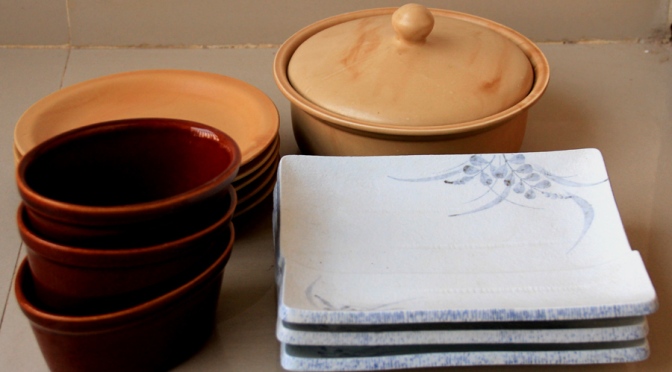
We spent about three hours there, hopping shops, looking for and picking up things we found appealing, of course after settling with the haggle first. My list includes glasses, cups, saucers, ropes (one of which I later gifted to Haji Zaffar, the horse breeder in Banni), a blue glass ash tray, a sturdy litterbin, wooden hangers, a pair of collapsible oars/paddles, and a full diving suit for my friend Sajal, who lives in Sundarbans.
BTW, there were some nice furniture also, and they said they would arrange for delivery too, but I refrained from picking up any, because I was still living out of my rucksack, at Kaushik’s apartment. Alang market sure deserves a few more visits from me, because I like collecting old stuff. But there are some people who have kinda dedicated their lives to find treasure in junk, and one such person I found on the internet is called Peter Knego. You can read about Peter and his Alang collections here.
On our way back, I got a call from Kaushik, who was in Calcutta to attend a family Puja. He suspected that he had suffered a mild facial paralysis. This sounded serious and I asked him to get to a hospital and get a check up done fast. Later at night, I called his phone and his wife answered – he had been admitted to the hospital, but the doctors have assured that it was not something of much concern. However, I couldn’t sleep at night, the sense of worry ruling my head.
Tea Mugs @ INR 180 for a set of six
Other crockery I bought – microwave safe bowls (dongas) @ INR 40 a piece, saucers @ INR 30 a piece, and curry bowl @ INR 60. The three square plates were bought in INR 180 @ INR 250/kg.
The Famous Blue… Ashtray! @ INR 60.
Ropes: The thinner multicolored came at INR 150/kg and the stouter green one at INR 200/kg. I had got two green bundles; one I gifted to a horse breeder I visited later.
October 22: Another good friend from Facebook, whom I have never met, called me up one day. “Hey, this is Rishit! Why don’t we meet up soon?” Rishit lived in Ahmedabad and I was about to go there to check the bicycle I found on an online buy & sell platform. Tomorrow is Diwali and we have a holiday, so I called Sanjay, our friendly neighbourhood auto-rickshaw guy and started towards Ahmedabad at about 5 pm.
My first stop was to be at Ghodasar (the d is pronounced between d and r as in ghoda = horse) to the house of Mr. Shelat, the bicycle’s owner. We drove along the Airport Road till the T junction from where left fork goes to the airport. We took the right fork and entered Ahmedabad. The change was evident – lots of people, lots of cars, honks, screeches, motorbikes et al, in summary a polar opposite to Gandhinagar. The last time I was in Ahmedabad was about 10 years back on an assignment to coordinate a video shoot and didn’t get to feel much of the city back then. On this ride, I could feel the city’s breath, its pulsating, throbbing life.
After a few stops to ask for directions, we found our destination at Ghodasar and checked the bicycle. I liked it immediately and we struck the deal. Now, it was time to head to Rishit’s place. The way was long and we passed through a number of wide roads and narrow alleys. I noted the Dilli Darwaza as we passed it. Finally we were at the cross where Rishit was waiting.
Directing Sanjay to come back for me near Acropolis Mall at 1 am, we walked towards Rishit’s house. It was an old bungalow with a peaceful garden, a high wall and a large gate. There were big trees around. The bungalow and its surroundings reminded me of Koramangala area of Bangalore. Here Rishit’s wife Poonam and their little daughter Keosha welcomed me. Once inside, I met Rishit’s parents and we started having a nice chat, mostly about wildlife, snake rescues and field equipment.
Rishit: pic from Facebook (I was not carrying a camera)
Here, I would take a bit to introduce Rishit. He is a fantastic architect and interior designer well known for his unconventional and striking works not only in India, but also in a few more places around the globe. He is a visiting lecturer at the NIFT (National Institute of Fashion Technology). But he is also a wildlifer from the core of his heart. Visiting sanctuaries, working for conservation awareness programs and snake rescues are a part of his life. Wait! The most important part is not yet over – he has combined both his passions and become a fabulous reptile enclosure designer. Designing reptile enclosures in a tropical country is a tough job and you have to be careful about the reptiles’ need of perfect environment and privacy as well as the display needs. Rishit has perfected this art. He has designed a few enclosures for various reptile parks and zoos and has been acclaimed for that. Even, the great Romulus Whitaker has certified him. Now, you understand the importance of this invite tonight. And boy, our conversation was one of finest times I would remember, with Bhabhi (Rishit’s wife), little Keosha, uncle and aunty joining in.
So the plans were set – Rishit would take his wife and daughter to a nearby temple for a ritual pre-diwali worship. And I’ll accompany them there. After that we will have dinner and the four of us would go for a night drive towards one of the wilderness areas (Thol may be).
As we boarded the car for the temple, Keosha was bubbling with the thought of the night drive. She kept telling me about the hedgehogs, hares, and snakes she has seen, stopping now and then to confirm her narratives from her parents. At the temple the queue was huge, so Bhabhi and Keosha decided to join the queue while Rishit and I came back to their home. Here, I had my first Gujarati dinner. With things like big and small breads of various kinds (rotlo, mathiya and chapatti are the ones I can recall), fantastic sabjees (vegetable curries), salads and desserts, it was one of the finest meals I ever had. At the table and after that, we carried on with our conversations while waiting for Bhabhi and Keosha to arrive. Once they were here and finished their dinner, we got into Rishit’s Ecosport and zipped out of the city towards the wild roads.
We drove past open spaces, where new apartment blocks were being built here and there. We drove past horse farms, rich men’s weekend houses and poor people’s shacks till we were on the road with darkness and woods around. The first sighting was a pair of spotted owlets that Keosha discovered with her torch. After spending a few minutes with these round headed beauties we advanced towards a place called Shilaj. The night was quiet and though we had expected at least a jackal or a hare if not hedgehogs, the only wildlife we saw was a big hare lying dead at the side of the road – killed by a speeding vehicle. We got down to check and found the body was still warm and external sign of injury was just a few drops of blood under its head, probably hit by a motorbike or a corner hit by a small car. With sad hearts we cruised along a few more kilometres but found nothing.
At about 1 am, Rishit drove us to Acropolis Mall and we waited for Sanjay. Sanjay arrived at 1-30 and I bade goodbye to my hosts and guides. The road from Acropolis to Kudasan was dark and I had “miles to go before I sleep.”
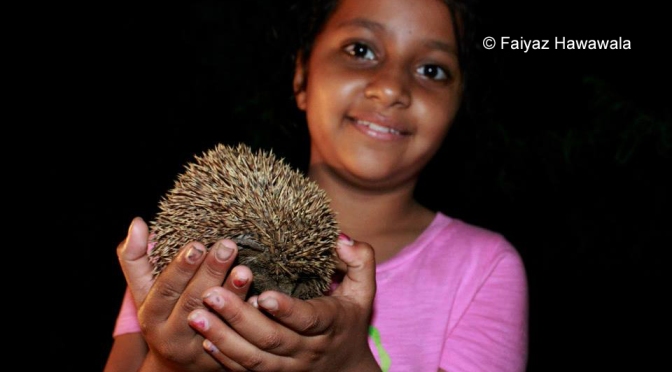
Note: The image featured with the title of this post is of Keosha holding a hedgehog in order to remove it from the road (where it could get killed easily). The animal was handled only because it was essential for its safety. This image was shot by my friend Faiyaz Hawawala, during another night out.
October 12: Mahua went back on 10th, the day before yesterday. Yesterday was a Saturday and I spent most of my daytime in chasing and photographing insects (and birds too) with my 100 mm macro.
A Tortoise Beetle
A Common Emigrant butterfly
A pair of Grey Francolins (heavily cropped image)
I also lazed around on the Western balcony and watched the people harvesting the Bajra (millets). Often, I would look up at the pigeons overhead hearing their gurgling calls.
The ubiquitous Blue Rock Pigeons
Kaushik and I both tried to photograph the squirrels running along the boundary wall below.
A Squirrel and a nut!
During the evening I watched a flock of starlings flying across the sunset.
Starlings in the Sun
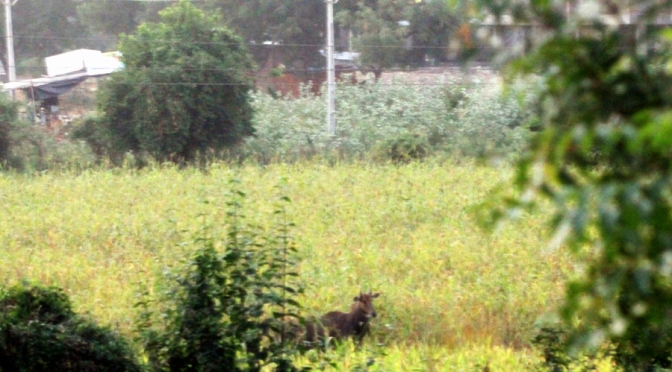
At night, the dogs barked differently! I told Kaushik that this is the kind of bark you hear when there’s a big mammal around. We spent some time guessing what the disturbance could be. Finally, this evening, when I was busy writing, Kaushik found the culprit and called me. We came out to the balcony and watched the vanishing form of the huge male Nilgai in the fading light of the evening. It was almost hidden till shoulders in the high millets and was happily munching on them. Nilgais or bluebulls are the largest of the Indian antelopes. Though they raid and destroy crops often, in most places they are protected by the immunity that derives from their name (Gai = Cow). I tried shooting the raider with the only lens that was around – the 100 mm macro. The result is a disaster, but who can beat my first Nilgai sighting in the city! That too from our balcony.
October 4: The last few days I’ve tried to get out of office early, mostly to visit the market at sector – 21. Mahua bought a few household things for us and we also shopped for groceries and fresh vegetables. In spite of having intentions to visit Adalaj and Indroda Park, the two major attractions here, we have not been able to make it to either. Today, we visited Serenity Library.
After landing up here, I’ve called up a few wildlife persons, most of whom I knew through Facebook, and tried to meet them, so that I could engage in some wildlife and/or animal rescue work during my weekends. But most of them were out on trips or otherwise busy; the only one who was not only available but eager to meet too was Haseeb Shaikh. Though a wildlife guy, my interactions with him also included our other common interests – nature education and hell yeah! poetry! We often would talk about Ghalib or Tagore or Baul or Sufi. Haseeb worked as the resident naturalist at Serenity Library and therefore we planned to visit him at his dream workplace.
It was Kaushik’s birthday today and we invited him to join us (kinda birthday trip!). Our other colleague, Sourav also came along. We hired an auto-rickshaw and drove towards Ahmedabad along the Airport Road. Calling Haseeb every now and then, we found our way to Koteshwar, the place where the library was. My three companions were still perplexed, thinking why I was bent upon taking them to a library, but their confused faces gave way to relaxed smiles once we reached the place.
It was not just a library, but an institute which boasted of a sprawling campus most of which was natural greens. Yes, there were lawns, walkways and gardens, but the major portion was wilderness that included scrub forests, bamboo groves, undulating lands, small lakes, vegetable fields and large, old-growth trees.
Haseeb, with his confident gait and pointed goatee appeared like a warrior chieftain, matching his Turko-Mongol ancestry that he proudly mentions. He welcomed me with a wide embrace and declared a surprise gift too. A rat snake (the shiny, black morph mostly found here) was rescued by him about half an hour back, and he offered me the honor to release it. We checked the snake for injuries and found a wound that was on its way to healing and took the snake near a well-vegetated waterbody for release.
Haseeb (with short hair) and I (with long hair): pic by Kaushik
Haseeb, Mahua and I check the rescued rat snake: pic by Sourav Maulik
Releasing the rat snake: pic by Sourav Maulik
After this we visited the library, the research units, lecture rooms and all other important places in the institute. Haseeb also took us on a guided walk through the campus and we saw blue water lilies and pink lotuses growing in the pond, porcupine burrows in the bamboo glade, a desert monitor scurrying off and a peacock at a distance. We also discovered Nilgai tracks and hares’ droppings. Mahua picked up a few fallen peacock plumes.
The walk: pic by Kaushik
The lily and the lotus
The bamboo glades
Wild Clerodendrum in bloom
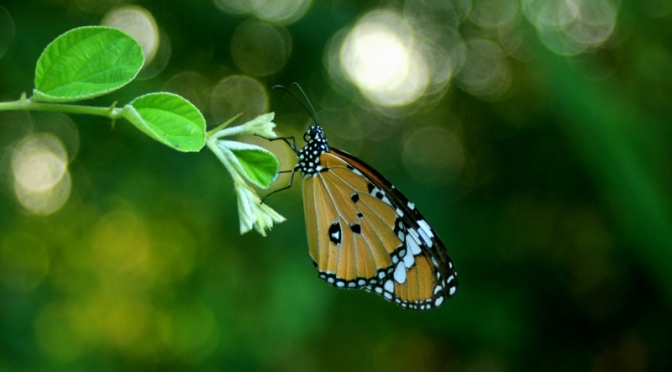
Plain tiger on Ber plant
Mahua with the peacock plumes
Later, Haseeb introduced us to Mr. And Mrs. Cambatta, the founders of Serenity Library. He also wanted to host my lecture on urban wildlife at the hall someday soon. We parted with another gift from Haseeb – a pack of welcome drink powder (similar to Burhani) while an episode of Mirza Ghalib played on youtube, the part where Ghalib had come down to Bengal to interact with the Bauls.
September 29: It’s about a week that I’ve landed here. Mahua arrived today carrying some more of my belongings. She’d be here for about 10 days, helping me set up. It’s a Monday today, so I came out of office, took an auto-rickshaw, received her at the airport, dropped her at the apartment and came back to the office. She had got a few Bengali spices with her and would engage in cooking some delicacies. Kaushik and I can expect non-self-cooked food tonight and for the next few days. I am also looking forward to the evenings to go out, eat and shop for things that would help me set up here.















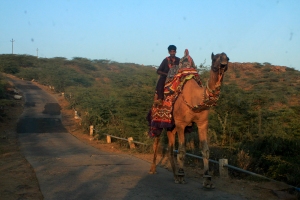 A camel named Shahrukh Khan













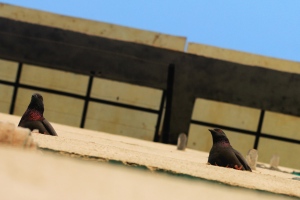 The ubiquitous Blue Rock Pigeons
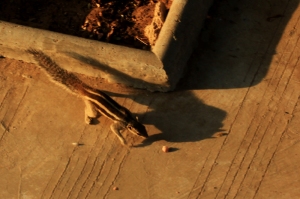 A Squirrel and a nut!


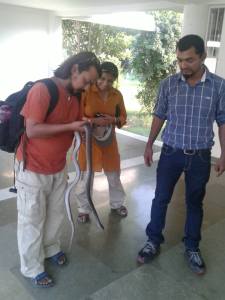 Haseeb, Mahua and I check the rescued rat snake: pic by Sourav Maulik


.jpg)